



AFE7683IABJ

Texas Instruments
595-AFE7683IABJ
AFE7683IABJ

Mfr.:

Description:
RF Front End 2-transmit 4-receiv e RF-sampling transc

ECAD Model:
Download the free Library Loader to convert this file for your ECAD Tool. Learn more about ECAD Model.

Availability

Stock:
Non-Stocked
Factory Lead-Time:
18 Weeks Estimated factory production time.
Minimum: 90   Multiples: 90
Unit Price:
$-.--
Ext. Price:
$-.--
Est. Tariff:
This Product Ships FREE

Pricing (CAD)

Qty. Unit Price
Ext. Price
$2,490.58 $224,152.20

Product Attribute Attribute Value Select Attribute
Texas Instruments
Product Category: RF Front End
RoHS:  
RF Front End
Brand: Texas Instruments
Country of Assembly: Not Available
Country of Diffusion: Not Available
Country of Origin: Not Available
Maximum Data Rate: 750 Mbps
Maximum Operating Temperature: + 85 C
Minimum Operating Temperature: - 40 C
Moisture Sensitive: Yes
Mounting Style: SMD/SMT
Operating Frequency: 5.2 GHz
Operating Supply Voltage: - 1.8 V, 1 V, 1.15 V, 1.85 V
Package / Case: FCBGA-400
Packaging: Tray
Product Type: RF Front End
Series: AFE7683
Factory Pack Quantity: 90
Subcategory: Wireless & RF Integrated Circuits
Technology: Si
Products found:
To show similar products, select at least one checkbox
Select at least one checkbox above to show similar products in this category.
Attributes selected: 0

This functionality requires JavaScript to be enabled.

USHTS:
8542390090
ECCN:
5A991.b

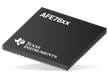
AFE76xx RF-Sampling Analog Front Ends (AFEs)

Texas Instruments AFE76xx RF-Sampling Analog Front Ends (AFEs) are high-performance, quad/dual channel, 14-bit, integrated RF sampling analog front ends (AFEs) with 9 GSPS DACs and 3 GSPS ADCs. These devices are capable of synthesizing and digitizing wideband signals. The high dynamic range allows the AFE76xx to generate and digitize 3G/4G signals for wireless base stations. In TDD mode, the receiver channel can be configured to dynamically switch between traffic receiver (TDD RX) status and wideband feedback receiver (TDD FB) status to assist DPD (Digital Pre-Distortion) of the Power Amplifier (PA) on the transmitter path.